Birds in the West
"Sea Birds"
with
Barry M. Thornton
At one time I found that the sheer numbers and concentrations of sea birds almost overwhelmed me. I was raised in the Interior of the province and I was only used to seeing song birds and flocks of waterfowl. But, on the coast of B.C. I found a vast variety of seagulls and other marine birds that had daily and seasonal habits that confounded me. But, I soon found that sea birds were a valuable angling barometer (See
“Wise Anglers Follow the Birds"
) and that individual species were a primary guide in my fishing. As a bird watcher I was delighted to identify these numerous new species and watch their individual and species specific behaviour.
 As a sea predator myself, an angler searching new waters, I initially gravitated to the known birds of prey. There were two that were obvious in my first few trips on saltwater, the
Bald eagle
and the
Osprey
. But, I was soon disappointed with the Bald eagle for I found that it was really a scavenger, or, an opportunist that stole fish from gulls. But, experience soon showed me who was the ‘king' of the saltwater birds. It was without question the Bald eagle as I watched the sea gulls panic whenever a Bald eagle made a threatening flight towards them. On other occasions I watched Bald eagles dive towards a gull that had captured a large herring or salmon grilse. The gull would quickly let go of the fish at the eagle's threatening dive and swing away in obvious escape. The eagle, rather than chase the gull, would drop to pick up the fish on the water. The coast is a ‘land-of-plenty' for this opportunistic predator-scavenger (see
“Bald Eagles"
).
As a sea predator myself, an angler searching new waters, I initially gravitated to the known birds of prey. There were two that were obvious in my first few trips on saltwater, the
Bald eagle
and the
Osprey
. But, I was soon disappointed with the Bald eagle for I found that it was really a scavenger, or, an opportunist that stole fish from gulls. But, experience soon showed me who was the ‘king' of the saltwater birds. It was without question the Bald eagle as I watched the sea gulls panic whenever a Bald eagle made a threatening flight towards them. On other occasions I watched Bald eagles dive towards a gull that had captured a large herring or salmon grilse. The gull would quickly let go of the fish at the eagle's threatening dive and swing away in obvious escape. The eagle, rather than chase the gull, would drop to pick up the fish on the water. The coast is a ‘land-of-plenty' for this opportunistic predator-scavenger (see
“Bald Eagles"
).
It would not be stretching the fact to say that there are millions and millions of sea birds on British Columbia's 27,000 km of indented shoreline. An accurate count would be near impossible because some are migratory and a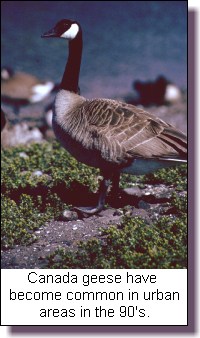 ll inhabit the complex diversified habitat known as coastal waters. For the birdwatcher new to coastal marine birds, dividing the birds into groups is the best way to begin species identification. A catalog showing the, “Distribution and Densities of Marine Birds on the Canadian West Coast," by the Canadian Wildlife Service of Environment Canada, groups the marine birds as follows:
loons
, grebes, cormorants, diving ducks, dabbling ducks, swans &
geese
, gulls, and auks.
ll inhabit the complex diversified habitat known as coastal waters. For the birdwatcher new to coastal marine birds, dividing the birds into groups is the best way to begin species identification. A catalog showing the, “Distribution and Densities of Marine Birds on the Canadian West Coast," by the Canadian Wildlife Service of Environment Canada, groups the marine birds as follows:
loons
, grebes, cormorants, diving ducks, dabbling ducks, swans &
geese
, gulls, and auks.
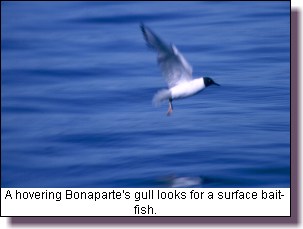
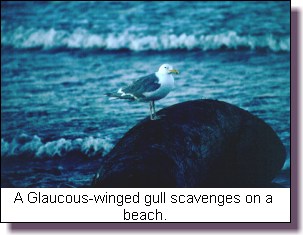
Gulls are the most obvious of all coastal birds. They always seem to be in the skyline, cruising with coastal winds or standing aloof on piers or the beach. There are eleven common species with the ‘Glaucous-winged gull' being the most common. Other common west coast gulls include the crow sized Thayer's gull and Herring gull, and the smaller falcon sized Mew gull and Bonaparte's gull. These latter two are often referred to as the ‘coho gulls' because of their habit of feeding on yearling herring in the same location as feeding coho salmon.
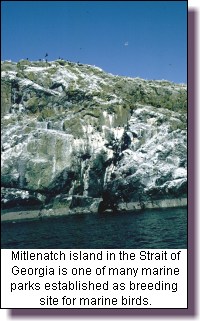
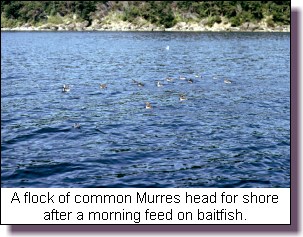
Auks form the next most common group of coastal birds. This group includes species such as; Common Murres, Rhinoceros Auklet, Ancient Murrelet, Marbled Murrelet, Pigeon Guillemont, Cassin's Auklet and the Tufted Puffin. Boating in any coastal bay or inlet, the traveler will spot these marine birds in groups and pairs. The constant peeping of paired murrelets is heard in areas where these birds have found schools of yearling baitfish. If watched for any length of time the observer will see these birds pop to the surface with one or two silver baitfish in their beaks.
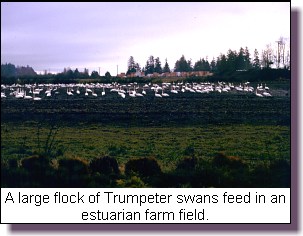
 Waterfowl form the next largest group of marine birds on the Pacific coast. These are migrating birds and will be found in largest numbers during the autumn. There are two species of swans found on the coast, the
Trumpeter swan
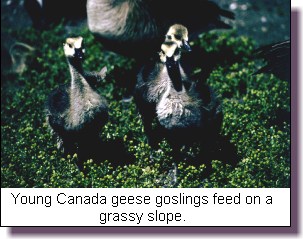
, the largest waterfowl in North America and, the Whistling swan. Four species of geese are common migrating visitors, Snows, Brant, White-fronted and Canada geese. Interestingly, the Canada goose is the only natural breeding goose in British Columbia. Numbers of Canada geese have increased dramatically in the 90's and they have become a serious wildlife nuisance in many areas particularly near urban centers.
Waterfowl form the next largest group of marine birds on the Pacific coast. These are migrating birds and will be found in largest numbers during the autumn. There are two species of swans found on the coast, the
Trumpeter swan
, the largest waterfowl in North America and, the Whistling swan. Four species of geese are common migrating visitors, Snows, Brant, White-fronted and Canada geese. Interestingly, the Canada goose is the only natural breeding goose in British Columbia. Numbers of Canada geese have increased dramatically in the 90's and they have become a serious wildlife nuisance in many areas particularly near urban centers.
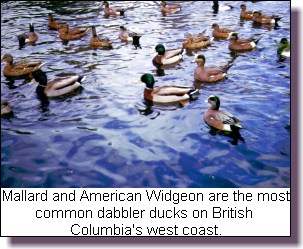
Dabbling ducks, what are often called, ‘bottom-up' ducks are common near freshwater estuarian areas, their preferred migrating resting and staging habitat. The Strait of Georgia marks the northern wintering zone of the Pacific Flyway. In moderate winters hundreds of thousands of Mallards, Northern Pintails, American Widgeon, Teals and other dabblers will be found in this area.
 Diving ducks are common throughout coastal waters at all seasons of the year. There are about a dozen common species and these can be divided into ‘Bay' ducks and ‘Sea' ducks. Bay ducks include the Barrow's Goldeneye, Bufflehead, Common Goldeneye, Merganser, Harlequin, and Greater Scaup. B.C. has the largest wintering concentration of Barrow's Goldeneye in its fjords and inlets. Sea ducks include the Surf, White-winged and Black Scoters, Old Squaw, and Harlequin ducks.
Missing from my groupings above, but to be included in a later article, are numerous other marine birds including various species of Cormorants, Jaegers, Skuas, shorebirds and Terns. As an angler I have often had the opportunity to watch the viscous Jaeger focus on a small gull that has been successful catching baitfish. In an endless pursuit the long tailed Jaeger has pursued the gull until it is forced to drop the baitfish. This appears to be a common tactic, like the antics of the Bald eagle. At other times I have watched high flying terns fold their wings and dive-bomb the water spearing their body downward to catch needlefish deep in the ocean. This is but a few visions of the excitements of birding in coastal waters. Bird visitors from other continents, and other North American Flyways, are often seen in this vast coastal area, drawn here by storms and for other natural reasons. It is an exciting region for the birder offering many opportunities to add to the ‘life-list'. Exploring the region does not require a boat as most species can be seen from the shore either at estuarian areas or along coastal beaches.
“The End"
Photo 1
|
Photo 2
|
Photo 3
© Copyright Barry M. Thornton
Barry M. Thornton
|