
Birds in the West
"Western Bird Watching"
with Barry M. Thornton
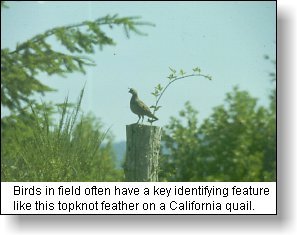 Bird watching or ‘Birding" as it is called by feathery aficionados
has been listed as the fastest growing outdoor activity by many sources
including Canadian outdoor leisure surveys. It is an outdoor pursuit
that is shared by young and old, families and clubs, wildlife scientists
and those who are simply outdoors on a walk or an adventurous hike.
It can be a simple experience or a complex activity depending upon the
wishes of the individual. It requires few special tools to enjoy ( a
bird guide book and comfortable clothes) yet, it can be expanded with
extensive investments in items like cameras, binoculars or spotting
scopes, and, libraries.
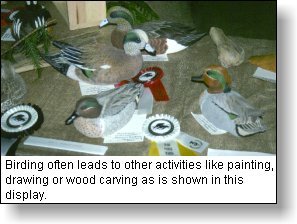 Birding
is also a fast growing activity on the internet with numerous national,
world wide and regional sites. British Columbia has a number of sites
and more seem inevitable. There are also numerous technical and informational
sites devoted to bird species and programs like those sponsored by the
Cornell Laboratory of Ornithology, the most comprehensive North American
bird study university. Birding
is also a fast growing activity on the internet with numerous national,
world wide and regional sites. British Columbia has a number of sites
and more seem inevitable. There are also numerous technical and informational
sites devoted to bird species and programs like those sponsored by the
Cornell Laboratory of Ornithology, the most comprehensive North American
bird study university.
Bird watching requires few tools for the beginner. Two items stand
out in my experience as the most important. The first is a good bird
watching guide book, easy to read and with good color definition. There
is no doubt that Roger Tory Peterson's field guides fill this need.
They are pocket sized and have clear and accurate colors for all species.
Should you live in British Columbia, as I do, I would recommend that
you purchase a copy of the Peterson Field Guide titled, "A Field Guide
to Western Birds". It shows all common and often uncommon bird species
found in North America west of the 100th meridian. Color drawings are
shown of all species including, in some cases, adult and juvenile stages
of maturity. A new feature in the third edition are range maps of all
species which show the general outline of the range of each species
including breeding and wintering zones.
 The
second most important item for the bird watcher is a good set of binoculars.
My favoured set are those with 10x power and a wide viewing field. I
have numerous sets of binoculars including those new ones that have
instant focus for the viewer. Many companies produce binoculars but,
it has been my experience that binoculars are like a good hat or a good
pair of shoes. The user must find a set that is comfortable for their
eyes and that give them a sharp and clear image. Naturally the more
expensive binoculars have better lenses and hence will provide those
sharper image. I would recommend that when you are going to buy, insist
that you be able to take the binoculars outside where you can look with
natural not artificial light. As well, watch a moving object like a
plane, car, or flying bird and see how easy it is to maintain focus
and clarity. Also. compare wide angle lens binoculars with narrow lenses.
Only when you are satisfied that the set you hold fits like a good hat
do you buy. The
second most important item for the bird watcher is a good set of binoculars.
My favoured set are those with 10x power and a wide viewing field. I
have numerous sets of binoculars including those new ones that have
instant focus for the viewer. Many companies produce binoculars but,
it has been my experience that binoculars are like a good hat or a good
pair of shoes. The user must find a set that is comfortable for their
eyes and that give them a sharp and clear image. Naturally the more
expensive binoculars have better lenses and hence will provide those
sharper image. I would recommend that when you are going to buy, insist
that you be able to take the binoculars outside where you can look with
natural not artificial light. As well, watch a moving object like a
plane, car, or flying bird and see how easy it is to maintain focus
and clarity. Also. compare wide angle lens binoculars with narrow lenses.
Only when you are satisfied that the set you hold fits like a good hat
do you buy.
 Once
you are equipped with these two key items, then you are ready for a
most fascinating outdoor experience. I would recommend that you start
a life list early. A life list is a formal list of birds that you have
seen and identified. You will be surprised at how quickly this life
list becomes a phobia. Some active birders actually and actively pursue
their ‘life list' in all their travels, even ‘to the ends of the earth',
as it has been said. Once
you are equipped with these two key items, then you are ready for a
most fascinating outdoor experience. I would recommend that you start
a life list early. A life list is a formal list of birds that you have
seen and identified. You will be surprised at how quickly this life
list becomes a phobia. Some active birders actually and actively pursue
their ‘life list' in all their travels, even ‘to the ends of the earth',
as it has been said.
One good place to start with your life list is with a check list of
birds of your local area. These are usually available at local tourism
offices, sporting goods stores, book stores, provincial parks, or from
Nature clubs in your area. After building on this local list another
list could be the official birds of each province. This is one of those
select lists which add special purpose for any birder. I have listed
the provincial birds as follows;
- Alberta: Great
Horned Owl
- British Columbia: Stellers Jay
- Manitoba: Great Gray Owl
- New Brunswick: Black-capped
Chickadee
- Newfoundland: Atlantic Puffin
- Northwest Territory: Gyrfalcon
- Nova Scotia: Osprey
- Ontario: Common
Loon
- Prince Edward Island: Blue Jay
- Quebec: Snowy
Owl
- Saskatchewan: Sharp-tailed Grouse
- Yukon Territory: Raven
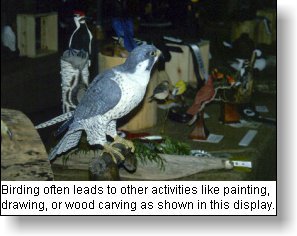 I
am still missing four provincial birds actually seen in their province;
the snowy owl, the blue jay, the Atlantic puffin and the gyrfalcon,
but, I hope to soon complete my own special Canadian Bird List. I
am still missing four provincial birds actually seen in their province;
the snowy owl, the blue jay, the Atlantic puffin and the gyrfalcon,
but, I hope to soon complete my own special Canadian Bird List.
Bird identification is without question easiest in the winter and spring
when bird are in their full adult plumage. In the summer and autumn,
immature birds with their various colors and adult feather molting often
makes it difficult to determine some species. As well, some birds take
up to four years to develop full adult plumage and these immature birds
may look like other species. Be prepared when identifying that you are
in fact looking at the species you have chosen. Guide books often provide
additional tips to help. All birds have a basic shape and size that
will assist in your identifying. As an example song birds have silhouette
shapes that are the size of a sparrow, the size of a robin, or, the
size of a crow. Another easy identifying feature lies with the actual
parts of the bird such as; the size and color of the tail and the outer
tail feathers; the colors on the breast and the belly; and, colors on
the chin, throat, forehead and crown of the head. Look at these key
locations with your binoculars to ensure that you have the correct identity.
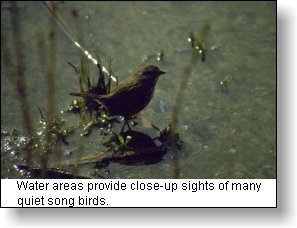
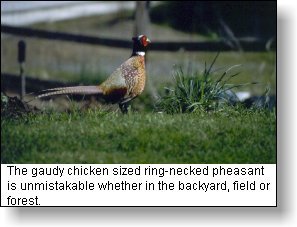 Bird
watching is a life long hobby that can become a part of your everyday
outdoor excursions whether they be walking or traveling. Some locations
such as marshes and estuaries have many visible birds and they are a
good place to start birding for the beginner. Once you have clearly
identified that first bird you will be hooked to a lifelong activity
which will provide uncountable hours of pleasure. After some successful
birding experience you will then find yourself searching to identify
the various calls and songs that are such a common occurrence in our
Canadian outdoors and, backyards. Bird
watching is a life long hobby that can become a part of your everyday
outdoor excursions whether they be walking or traveling. Some locations
such as marshes and estuaries have many visible birds and they are a
good place to start birding for the beginner. Once you have clearly
identified that first bird you will be hooked to a lifelong activity
which will provide uncountable hours of pleasure. After some successful
birding experience you will then find yourself searching to identify
the various calls and songs that are such a common occurrence in our
Canadian outdoors and, backyards.
"THE END"
© Copyright Barry M. Thornton
Barry M. Thornton
|