Dragonflies
Order: Odonata, suborder Anisoptera
Family: Aeschnidae and Gomphidae
Indentifying
Features
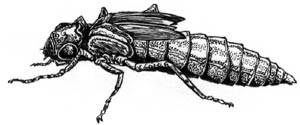
Sometimes called the green darner or devil's darning needle, Aeschnidae
nymphs have an hour-glass-shaped body between two and five-cm long.
Green and brown are typical colors, but coloration is dependent on habitat.
Its jet-propelled motion is achieved by taking in water through the
rear gill chamber and quickly expelling it in a stream; it is capable
of quick successive bursts of motion ranging between eight and 15 cm
each. It dwells in dense weedy areas where it is a fierce predator capable
of hunting down and capturing even small fish. Gomphidae nymphs are
smaller, with a more oval, squat body, but have the same jet-propelled
system of movement. They are not as active as the darners and prefer
to remain buried in mud bottom or deep in weeds. They are ambush feeders.
Light olive green, tan and brown are typical colors.
 |
|
|
What
to Look For
Like the damselflies, dragonflies crawl out of the water to complete
their transformation to adults. Unlike damselflies, the shoreward migration
is achieved by crawling along the bottom. Watch for them clinging to
shoreside reeds or debris. Any sudden appearance of large numbers of
adult dragons should send anglers searching the shoreline.
Life
Cycle
Nymphs can take as long as three or four years to mature, evolving through
a series of molts, or instars. When mature, the nymph crawls slowly
shoreward along the bottom, seeking something to crawl out on. Once
out of the water it waits to dry, its skin splits and the adult emerges.
Adults remain among the reeds for some time, waiting for the final transformation
to occur. Females return to the water after mating and deposit their
eggs while flying low over the water. Emergence continues through the
hot- weather months.
When
to Fish
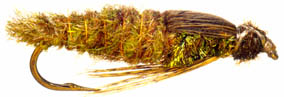
Dragonfly nymphs are a good searching pattern and can be fished as close
to bottom as possible through the year. They are the patterns to turn
to when there are no indications of any other activity. Aeschnidae patterns
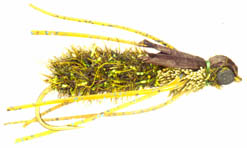
are better for general-purpose searching, but the squat Gomphidae imitations
are valuable, especially over mud bottoms. Peak hatch activity starts
in early July.
How
to Fish
Dragonfly patterns are suited to the "meditation style" of
wet-line fishing. Some anglers use dry lines and long leaders with weighted
flies to reach bottom, but sinking lines work well for those who know
them and this is the better way to fish dragonfly nymphs. Staying as
close to bottom as practical is important as these nymphs rarely stray
far from their weedy or muddy homes. A floating deerhair pattern fished
over a sinking line which has been allowed to bury itself in the weeds
can produce large fish.
Fishing
Tip
Despite their jet-drives, dragonfly nymphs rarely scoot along; the most
effective retrieves are the ones which imitate the nymphs' slow creeping
stalk among the weeds. Fly color, as always, should be matched to the
waters being fished. Nymphs are a lighter color immediately following
a molt; trout will often feed selectively on molting nymphs.
Be sure
to visit Fishbc.com for angling information!
Back to introduction