|
|
|
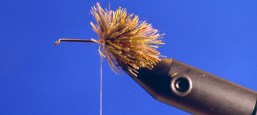
Step 1:
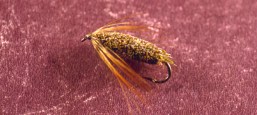
Debarb hook, place in vise and form your basic wrap leaving the thread hanging at the rear of the hook. Don't build up to much thread as this inhibits the spinning of the deer hair. Select a stack of premixed deer hair. About the diameter of a pencil is fine. Spin a body of deer hair all the way up the hook shank to the eye. Remember to leave room for the head.
|
If
I have one weakness it's my liking for a good dragon fly nymph pattern.
Dragon nymphs can be intricate in design, and for the stillwater
fly tier they can be what the stonefly nymph is to the river tier
a source of constant imitation. Angling friend Duncan Laird is a
big fan of dragon fly nymph patterns also. Duncan and I have had
long discussions regarding tying and fishing these underwater predators.
This
pattern represents the spider like nymphs of the family Libellulidae
. The most common species of this family found in British Columbia
is Sympetrum . Adults of this family of dragon fly are identifiable
by their distinct wing patches. Hence the name, red shouldered dragon.
Some call this family of dragon flies Gomphus , Gomphus
are not as common in B.C. as the Sympetrum species and can
be recognized by their distinct club tails in the adult stage. Differing
characteristics of these two species in the nymphal form include
the overall body shape, stout antennae of the Gomphus and
the different structured mouthparts.
Sympetrum have a 2 to 3 year life cycle. They are widespread
across the province but I have found the greatest populations in
the clear water lakes of the interior region. They inhabit chara
weed in large numbers. Lakes such as Roche, White, and Peterhope
have dense populations of these insects. The nymphs crawl across
the bottom and out of the water to emerge. Emerging nymphs crawl
up docks, weeds and trees for the final transformation into the
adult stage. Primary emergence time is usually from mid June through
August. Keep your eyes peeled along the shoreline for the nymphal
shucks and birds such as robins working the shoreline picking up
the nymphs as they crawl out of the water.
|
|
|
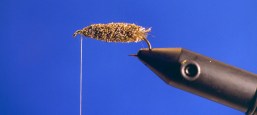
Step 2:
Trim the body to a cigar shape. Remember to keep the gape
of the hook clear so as not to impede the hooking ability
of the fly.
|
Sympetrum nymphs are sedentary ambush feeders, although they
have the same jet propulsion system other species of dragon fly
nymphs are famous for. However they prefer to cover or bury themselves
in the bottom substrate and wait for their prey to come to them.
Sympetrum nymphs will wait until their prey is practically,
"between their eyes" before grasping their prey in their spoon shaped
labium. This tactic is deadly and they seldom miss. Popular food
items include shrimp, mayfly nymphs, damsel nymphs, etc. Essentially
anything they can get their jaws into.
Duncan
prefers to fish this pattern with a Stillwater line. Allow the pattern
to slowly sink to the bottom. Retrieve the fly in 4 to 6 inch strips
as though you were shaking a thermometer. Duncan feels that this
retrieve adds to the success of this pattern. During sedge hatches
Duncan has also used this pattern successfully. Tied in smaller
sizes the overall size, shape, colors, and behavior of this pattern
mimics the sedge pupa swimming just under the waters' surface. Don't
forget to give this pattern a try when probing the drop offs on
slow days.
|
|
|
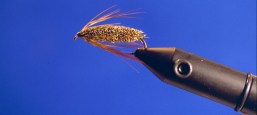
Step 3:
Select an appropriate pheasant rump hackle. Strip away the flue at the base of the feather. Tie in the hackle wet fly style with the shinny side of the feather facing towards you. This way the fibers will naturally sweep rearwards. Wind the hackle 2 to 3 times maximum. You do not want a heavily hackled fly. Apply head cement and go fishing!
|
Tying
this pattern is easy. What makes this pattern unique is the method
Duncan uses to mix the various colors of deer hair. He selects the
colors, removes any under fur and throws them all together in a
bowl such as a margarine container, and mixes them by hand as though
it was dubbing. Once mixed Duncan selects a "stack" of deer hair
and spins it onto the hook shank. This method of mixing creates
a very natural looking body made up of a wide variety of colors.
The particular pattern illustrated in this column utilizes 8 different
shades of deer hair. You can vary the overall color to simulate
various stages in the nymphs' life. Add more light olive and lime
green to simulate a freshly molted nymph or more dark greens and
olives for a mature nymph. If you like you can tie this pattern
with natural deer hair and color it with permanent markers but the
overall effect is not the same. Next spin and clip the deer hair
body to a cigar shape. Selection of the pheasant rump is also important.
Duncan likes to use a brown pheasant rump feather. Make sure the
barbs of the feather are no longer than the body of the fly and
that they are stiff in nature. You do not want the hackle fibers
to lie tight to the body but rather stiff and flared so optimum
movement can occur.
This
pattern is a simple but lethal design. In years past Duncan used
his pattern to great effect on White Lake. Stomach analysis revealed
concentrated feeding upon Sympetrum nymphs.
Dunc's Floating Carey
-
Hook: Tiemco 5263 or Mustad 9672 (#6-#10)
-
Thread: Green 6/0 or Monocord
-
Body: Mixture of spun and clipped deer hair
-
Hackle: Pheasant Rump, Brown Phase

|