Step 1:
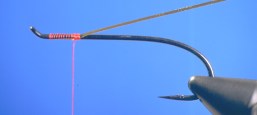
Attach the tying thread at the front of the hook. Close the hook eye with tying thread. Attach a long length of silver Mylar just behind the return of the hook eye. Position the Mylar so the silver side will show on the fly.
As the seasons change so do their colors. The greens of spring are replaced by red, orange and yellow come fall. This change of color not only happens outside but at my fly tying bench too. The somber earth tones associated with trout patterns are replaced with the bold, warm colors used to dupe salmon and steelhead. I enjoy this change of color and hook size. The large irons used for these anadromous fish absorb a lot of materials and thread without the same consequences of their smaller trout cousins. I swear I can use an entire spool of 6/0 thread on a large 2/0 hook. But despite this perception it pays to remain disciplined at the vise to ensure your flies are balanced and neat.
Step 2:
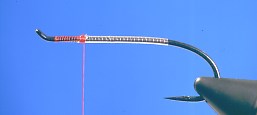
Wind the silver Mylar down the hook shank in close butting turns. Once you have reached about halfway between the hook point and the back of the barb wind the Mylar forwards to the tying thread. Secure the Mylar and tie off. Winding the Mylar in this fashion makes for a neat durable body.
Marabou is one of those magical fly-tying materials that is at home in any environment. Fly tyers worldwide attest to its versatility and animation. From freshwater to salt marabou is tough to beat. The sensuous flowing motion of marabou has seduced steelhead and salmon tyers. Using marabou as a base component American angler George Cook created the Alaskabou series of flies. The Alaskabou series have been described as a blend of Alaskan salmon patterns traditional steelhead and tarpon flies. The Popsicle is probably the most famous of this series but there are others, appropriately named as a result of their overt colors and bold looks. These include the Tequila Sunrise, Pixie's Revenge, Showgirl and the Candy Cane. A box filled with these designs would more than cover the loud spectrum of steelhead and salmon flies. Popsicles are a straightforward tie. In the course of an evenings tying you can ream off dozens. This economy makes loosing flies on rocks and other sunken snags not as gut wrenching as loosing a General Practitioner or other complex tie you spent considerably more time on.
Step 3:
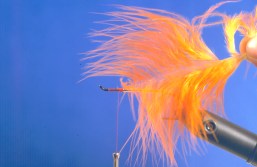
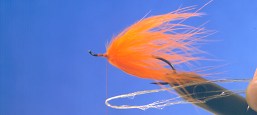
Select a single plume of hot orange marabou and tie it in place by the tip just behind the return of the loop eye.
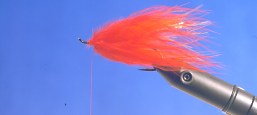
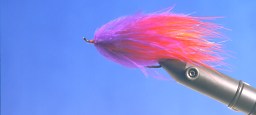
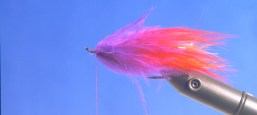
The Popsicle began as three colors of marabou tied in at the front of the hook. This theme is common throughout the entire Alaskabou series. I have added more flash by first covering the hook shank with silver Mylar. From there tie in a full plume of hot orange marabou. Wind the marabou forward 3 or 4 times then tie off and trim the excess. At this point I through in a few strands of pearlescent Flashabou for added glitz. Tie in a flame red plume of marabou followed by a finishing of purple marabou. A neat red head finishes the fly. Don't get carried away and over dress the pattern. Too many wraps of marabou defeats the breathing motion of the fly. In the cold flows of winter a lightly dressed fly sinks quicker than a bulky over dressed affair. Full plumes of marabou work great on larger Popsicles but for smaller versions you can tie the marabou on in clumps. Use only enough thread pressure to control the material at first. With the marabou in place use a combination of thread pressure and finger massage to work the clump completely around the hook shank. Inserting marabou into a dubbing loop is another popular method. Once twisted a dubbing loop makes a durable marabou hackle. I don't like to pinch the marabou to length, as the tapered tips of the marabou are important to impart the right action to the fly.
Step 4:
Wind the marabou forward in close turns about 3 or 4 times. With each wrap sweep the marabou back to avoid tying it down by accident. Tie off and trim any excess marabou.
For the majority of my winter steelhead fishing I present the Popsicle using the traditional down and across approach. A type 4 or 5 density sink tip in conjunction with a short 4 feet or less leader suits the majority of the water I fish. Used in swift water the Popsicle tends to collapse turning this vibrant pattern into nothing more than a colored stick. Try to hold back slightly through the drift and swing to further animate the pattern. If you are fortunate to hook into something solid and alive hang on and play your catch with skill for successful fly fishing for winter steelhead is measured in casts, thousands of them!
The Popsicle
Hook: Tiemco 7999 #2/0-#8
Thread: Red 6/0
Body: Silver Mylar
1st Wing: Hot Orange Marabou Mixed With Pearlescent Flashabou
2nd Wing: Flame Red Marabou
3rd Wing: Purple Marabou
Step 5:
Loop a few strands of pearlescent Flashabou around the tying thread. Slide the marabou up the tying thread and into position on the hook. Tie the Flashabou in place. Trim the Flashabou in a staggered fashion so it shimmers throughout the fly.
Step 6:
Tie in a plume of flame red marabou in by the tips directly in front of the orange wing. Wind the flame red marabou in the same fashion as the hot orange. Trim the excess.
Step 7:
With the red marabou in place tie in a plume of purple marabou for the third and final wing. Wrap it forward in the same manner as the previous two wings. Tie off, neatly trimming the excess.
Step 8:
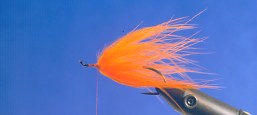
Spin the bobbin counter clockwise when looking from the top. This untwists the 6/0 thread enabling you to build a neat head using flat wraps of tying thread. Build a neat head whip finish and apply head cement.