
Understanding
Fall Fly Fishing in BC
with
Brian Chan
Fall fly
fishing in the interior lakes can offer some of the fastest action of
the season and the best chances for catching big fish. Even the most popular
lakes are relatively uncrowded, often you are the only person fishing
the lake that day. Weather conditions are the biggest factor in having
an enjoyable day on the water as well as dictating whether the fish will
be active or dour.
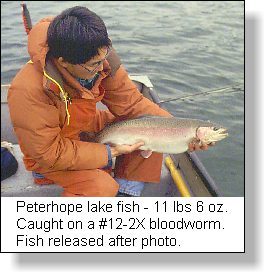 How
late can you fish a lake? I have had great success fishing lakes that
had only a 2 acre patch of open water left. My most memorable day of fall
fishing occurred on Peterhope
lake several years ago. My fishing partner and I arrived at the lake on
the particular late October day. It was cold but the winds were calm and
blue skies were evident for as far as the eye could see. We were a little
surprised to see about 30 metres of ice had already formed out from the
edge of the lake. We quickly got the boat unloaded and pushed it out over
the rather thick shore ice. No fish were moving on the surface so we motored
out to the drop-off and then began slowly motoring parallel to the edge
of the drop-off searching for cruising fish. Peterhope lake is one of
the clearest lakes in the southern interior of B.C. making it easy to
see fish with Polaroid sunglasses. It wasn’t long before we spotted
several big fish darting off the shoal over the drop-off and into deep
water. We anchored where the fish were seen and set up floating lines,
long leaders and weighted leech patterns. Our plan was to cast the leeches
parallel to the edge of the steep drop-off, wait for the flies to sink
close to the bottom and then retrieve slowly back to the boat. No action
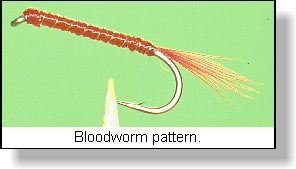
occurred for the first 30 minutes and then I noticed a bloodworm, or a
maroon chironomid larvae floating by in the surface film of the lake.
Lights began to flash in the fishing section of my brain and we quickly
switched to weighted bloodworm patterns and fished them the same way we
had been fishing the leeches. I hooked a fish on my second cast. I could
tell the fish was heavy by the way it was shaking it’s head as it
headed out for deep water. We ended up pulling anchors and chasing the
fish as I did not have enough backing to stop the long runs. We took a
length and girth measurement and pumped his throat prior to release. To
our excitement, the large male fish was feeding on big maroon chironomid
larvae. We quickly re - anchored and landed another 5 fish that were all
over 3 kg before the wind came up and iced-up rod guides made casting
and retrieving too difficult. How
late can you fish a lake? I have had great success fishing lakes that
had only a 2 acre patch of open water left. My most memorable day of fall
fishing occurred on Peterhope
lake several years ago. My fishing partner and I arrived at the lake on
the particular late October day. It was cold but the winds were calm and
blue skies were evident for as far as the eye could see. We were a little
surprised to see about 30 metres of ice had already formed out from the
edge of the lake. We quickly got the boat unloaded and pushed it out over
the rather thick shore ice. No fish were moving on the surface so we motored
out to the drop-off and then began slowly motoring parallel to the edge
of the drop-off searching for cruising fish. Peterhope lake is one of
the clearest lakes in the southern interior of B.C. making it easy to
see fish with Polaroid sunglasses. It wasn’t long before we spotted
several big fish darting off the shoal over the drop-off and into deep
water. We anchored where the fish were seen and set up floating lines,
long leaders and weighted leech patterns. Our plan was to cast the leeches
parallel to the edge of the steep drop-off, wait for the flies to sink
close to the bottom and then retrieve slowly back to the boat. No action
occurred for the first 30 minutes and then I noticed a bloodworm, or a
maroon chironomid larvae floating by in the surface film of the lake.
Lights began to flash in the fishing section of my brain and we quickly
switched to weighted bloodworm patterns and fished them the same way we
had been fishing the leeches. I hooked a fish on my second cast. I could
tell the fish was heavy by the way it was shaking it’s head as it
headed out for deep water. We ended up pulling anchors and chasing the
fish as I did not have enough backing to stop the long runs. We took a
length and girth measurement and pumped his throat prior to release. To
our excitement, the large male fish was feeding on big maroon chironomid
larvae. We quickly re - anchored and landed another 5 fish that were all
over 3 kg before the wind came up and iced-up rod guides made casting
and retrieving too difficult.

 Trout
feed aggressively during the last 6 weeks prior to freeze-up in order
to build up fat reserves for the long winter ahead. Highly sought after
food items include shrimp
, leeches
, water
boatman , chironomid
pupae and larvae, dameslfly
and dragonfly
nyphs. All of these food sources live in the shoal or drop-off zones of
the lake or in water that is generally less than 6 metres deep. Often
the best fishing action will be in 2 metres of water or less, right tight
to shore. Some lakes offer excellent wading opportunities as the fish
are feeding that shallow. This shallow water feeding often allows the
angler to use a floating fly line in combination with varying leader lengths
and weighted or unweighted flies. Trout
feed aggressively during the last 6 weeks prior to freeze-up in order
to build up fat reserves for the long winter ahead. Highly sought after
food items include shrimp
, leeches
, water
boatman , chironomid
pupae and larvae, dameslfly
and dragonfly
nyphs. All of these food sources live in the shoal or drop-off zones of
the lake or in water that is generally less than 6 metres deep. Often
the best fishing action will be in 2 metres of water or less, right tight
to shore. Some lakes offer excellent wading opportunities as the fish
are feeding that shallow. This shallow water feeding often allows the
angler to use a floating fly line in combination with varying leader lengths
and weighted or unweighted flies.
Chironomid
larvae or bloodworm fishing is especially good late in the fall as these
worm-like larvae get swept off the bottom as the lake is mixing from wind
action. This is how the larvae get trapped in the surface film. Trout
love to eat these hemoglobin-filled larvae and the observant angler can
cache in on this feed action.
The most
important late fall food item are the protein rich Gammarus and Hyallela
shrimp. Grammarus, the larger of the two species, can reach almost 15
mm in length, while Hyallela rarely exceed 3 mm in length. Both are found
in the productive lakes of the interior region of the province. Gammarous
are most commonly found in the bottom vegetation growing on the shoal
zones of the lake. Hyallea frequent the whitish/yellow marl 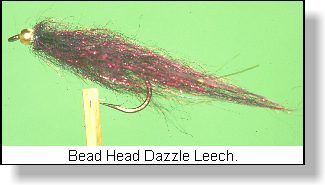 bottom
of shoals that are common in very clear lakes. Remember to fish your patterns
close to the lake bottom and try to match the colour of the shrimp present
in the lake your are fishing. Shrimp, like other trout food sources vary
their colouration to the colour of the shrimp present in the lakes your
are fishing. Shrimp, like other trout food sources vary their colouration
to the colour of the water and habitat they are living in. bottom
of shoals that are common in very clear lakes. Remember to fish your patterns
close to the lake bottom and try to match the colour of the shrimp present
in the lake your are fishing. Shrimp, like other trout food sources vary
their colouration to the colour of the shrimp present in the lakes your
are fishing. Shrimp, like other trout food sources vary their colouration
to the colour of the water and habitat they are living in.

Leeches are
always a good fall pattern because they are readily available and also
a big food item. I have found the best colours to fish are maroon, black
and maroon, dark green and brown. Try using patterns that have some flash
to them or a bead head that gives the fly a bit more action during the
retrieve. Woolly buggers in the above mentioned colours are always worth
carrying in your fall fly box. Try a slighter faster strip retrieve to
get those really big trout excited.
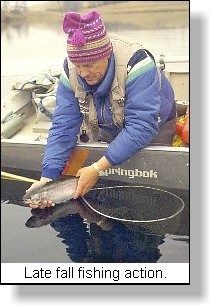 Anglers
can also encounter hatches of smaller-sized chironomids late in the fall.
The trout are already very familiar with these hatches and will readily
feed on them. Remember you won’t see big sized pupa as was the case
in the spring. Be prepared will patterns tied in sizes #14 to #16. Anglers
can also encounter hatches of smaller-sized chironomids late in the fall.
The trout are already very familiar with these hatches and will readily
feed on them. Remember you won’t see big sized pupa as was the case
in the spring. Be prepared will patterns tied in sizes #14 to #16.
Fall fishing
does not last long but those that are prepared to fish in cold weather
can have some spectacular action that will continue right up to complete
ice cover.
Brian Chan
riseform@shaw.ca
Brian's
Articles...
|