Purposeful Approaches to Lake Fishing
article by Peter at Fred's Custom Tackle
insect illustrations by Barb Krimmer
The long awaited trip into one of the
interior lakes will be accompanied with questions
regarding the conditions of weather, roads and fishing
conditions. Both spring and autumn seasons can be
beautiful times to fish lakes, they can also be times of
cold weather, high winds and even hail and snow. These
factors will at times make it hard to find any lake with
consistently good fishing throughout the day. When you do
get a small hatch or feeding activity it will be
important to recognize and take advantage of it.
Search the Shoreline
Upon arrival at your chosen destination
an investigative look along the shoreline can answer some
of your questions regarding insect activity. Aquatic
insects will show themselves if water temperatures have
risen enough to start activity. The wash area of the
shoreline will reveal the pupal skin or "shuck"
of some insects which have hatched fairly recently.
Insect Identification
The identification of nymphs, pupae or
the shucks of the same is best described as follows:
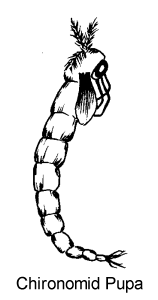 Chironomid pupae - total length 1/8" to
½", thin body thicker wingcase/thorax, white gills
in head area, no tail
Chironomid pupae - total length 1/8" to
½", thin body thicker wingcase/thorax, white gills
in head area, no tail
Mayfly nymph - total 1/8" to 5/8",
thicker body portion with slightly thicker
wingcase/thorax, no gills, short legs are usually
apparent, evidence of tails - 3" in total.
Sedge/Caddis pupae - total length 3/8" to
7/8", modest body portion, thick wingcase/thorax
area, prominent head, long legs, no tail.
Damselfly nymph - total length 3/4 to 1 1/4",
long slender body with thicker wingcase/thorax, long
legs, prominent eyes, flipper-like tails, 3" in
total.
Dragonfly nymphs - total length of Darner is 1
½" to 2 ½" and Gomphus is 3/4" to 1
1/4". Fat elongated body with large wingcase/thorax,
sturdy long legs, large head and eyes, no tail.
Both dragonfly and damselfly nymphs
will climb reeds, rocks and branches to emerge.
Inspection of these areas will reveal the shucks if
"hatching" has occurred. Larger sedges will
also be found in similar areas.
A look in the shallows may reveal
shrimp or leech activity as well. The colour and size of
the shoreline inhabitants is often the same as those
found in open water areas.
The husks of most insects will reveal
the size and type, the colour will be revealed by the
live pupae or nymph. In the case of chironomid, mayflies
and sedges the adults are usually the same colour as the
pupae or nymph.
Damselfly and dragonfly nymphs usually
have the same colouration as the bottom or vegetation
they frequent.
Search the Water
 Having
made a quick inspection of the shoreline, it's time to
get fishing. Once on the lake, look around! Surface
activity of fish will almost always indicate surface
feeding. Look closely along the surface for adult
insects. Early in the season the most likely is
chironomid and mayfly. Later, dragonflies, damselflies
and sedges will follow.
Having
made a quick inspection of the shoreline, it's time to
get fishing. Once on the lake, look around! Surface
activity of fish will almost always indicate surface
feeding. Look closely along the surface for adult
insects. Early in the season the most likely is
chironomid and mayfly. Later, dragonflies, damselflies
and sedges will follow.
The prior shoreline inspection along
with the inspection of adult insects on the lake will
provide you with enough information to chose a most
likely fly pattern, colour and size! Water depth and
temperature and the make up of the bottom will dictate
which areas will produce the first hatches. It is fairly
common in early season to have isolated hatches in
specific areas. Do not troll through or anchor in these
areas. It is much better to anchor or drift along within
casting distance. When anchoring try and do so quietly to
avoid putting the fish off! Two anchors will prevent your
boat or float tube from "swaying" in the wind,
it will also make your casting easier and your retrieve
more effective!
If there is no visible surface activity
by fish but there is an obvious hatch, it is usually safe
to assume that the fish are feeding subsurface. Again it
is best to cast into those areas and retrieve your fly!
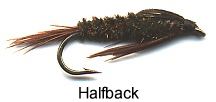
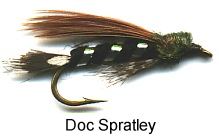 The absence of surface activity by either fish
or insects is a sobering experience. It is common to
experience short hatches and feeding in the early season.
Between these times, it is often most productive to fish
with attractor patterns or "meat and potato"
type flies, the most common being: Doc Spratley's,
Halfbacks, Careys, Werner's Shrimp, Dragonflies, Wooly
Buggers and Leeches (see The Fly Patterns of BC). A fish caught at such times can open the door
to success. A stomach pump can be used to extract a
sample of actual food, which that fish has been feeding
on. Carefully read the instructions on using a stomach
pump, this will ensure the fish is unharmed.
The absence of surface activity by either fish
or insects is a sobering experience. It is common to
experience short hatches and feeding in the early season.
Between these times, it is often most productive to fish
with attractor patterns or "meat and potato"
type flies, the most common being: Doc Spratley's,
Halfbacks, Careys, Werner's Shrimp, Dragonflies, Wooly
Buggers and Leeches (see The Fly Patterns of BC). A fish caught at such times can open the door
to success. A stomach pump can be used to extract a
sample of actual food, which that fish has been feeding
on. Carefully read the instructions on using a stomach
pump, this will ensure the fish is unharmed.
Identifying Adult Insects on the Water
Let's assume that there is a hatch and
adult insects are visible on the surface. These adults
are fairly simply to identify:
Chironomid - mosquito like in
appearance, fairly long bodies up to ½" overall,
grey, green or black body common, 1 pair of clear
elongated wings lying parallel to the body at rest, no
tail.
Mayfly - body style similar to
chironomid but of heavier build, 2 pairs of wings (large
& small) held in an upright position, body colours of
grey, greyish brown and olive are common, three long
dainty tails.
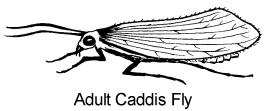 Sedge/Caddis - body is quite large and
plump, 2 pairs of elongated wings held parallel to the
body in a "wedge" shape at rest, long legs,
long antennae, no tail. Grey, black and brown common
colours.
Sedge/Caddis - body is quite large and
plump, 2 pairs of elongated wings held parallel to the
body in a "wedge" shape at rest, long legs,
long antennae, no tail. Grey, black and brown common
colours.
Damselfly - very long slender
bodies, blue and black or brown and grey, 2 pairs of long
clear wings held parallel to the body at rest, large head
with small but obvious eyes.
Dragonfly - Darner and Gomphus -
thick, very long body and large thorax, blue and black
through red, brown and black common colours, 2 pairs of
long clear wings held perpendicular to the body in flight
and at rest.
Fishing the Surface
Surface feeding fish, usually target on
the emerging insect as it frees itself from the pupal
case and dries its wings. At this time a floating line
with an "emerger" or "adult" dry fly
will produce the most excitement. The use of fly floatant
or "dryshake" will greatly increase the
floating ability of your dry flies! Fish that are
actively feeding on adults or emergers often rise
predictably at intervals as they cruise along the
shallows or drop-offs. Watch for this and try and place
your fly in the path of a predictably rising fish! A good
tip when fishing a dry fly is to allow the fish to take
your fly but wait until you feel your line tighten before
raising your rod.
At times a nymph or pupae pattern can
be fished near the surface by using a floating line with
the leader treated with floatant to within 3 feet of the
fly.
Fishing Chironomids
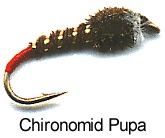 Fishing
chironomid pupae with a floating fly line can be
extremely fun and effective. It can also be very
demanding on your patience and attention. To get the most
out of fishing chironomids, it is best to follow some
important rules:
Fishing
chironomid pupae with a floating fly line can be
extremely fun and effective. It can also be very
demanding on your patience and attention. To get the most
out of fishing chironomids, it is best to follow some
important rules:
- anchoring your boat or float tube is recommended.
- use a fine tippet for best results.
- ensure your leader breaks the surface film by using
weighted flies, sinking (fluorocarbon) tippet, lead wire
or microshot on your leader or leader sink solutions.
- your leader length must allow your fly to get to the
depth of feeding fish - sometimes over 20'.
- cast mostly down wind to prevent excessive bellies from
forming in your line.
- allow plenty of time for your fly and leader to sink to
a vertical position in relation to the floating line.
- floating strike indicators will make it easier to watch
your line.
- keep your line straight and your rod tip low.
- at the slightest take, lift your rod tip high and allow
for the line to be taken out to avoid breaking your fine
tippet.
- most of all, take your time on the retrieve,
chironomids seem to take forever to rise vertically to
the surface, it is most common to retrieve too fast.
Fishing Subsurface
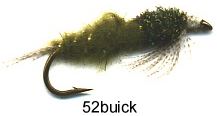 When
fishing nymph, wet or attractor patterns, it is important
to fish a fly line, which will allow for the proper speed
of retrieve without dragging up weeds on every cast. In
shallow water, 2' to 6' deep, floating lines will work
well. Water 6' to 15' is fished well with intermediate or
type One lines. Type two sink-tip or full sinking lines
fish well in depths to about 25'. It is also quite
important to use a "countdown" method between
the completion of your cast and the beginning of your
retrieve. This will ensure your depth is consistent and
will allow you to fish effectively and avoid bottom. Your
retrieve should mimic the naturals you are imitating in
both speed and action.
When
fishing nymph, wet or attractor patterns, it is important
to fish a fly line, which will allow for the proper speed
of retrieve without dragging up weeds on every cast. In
shallow water, 2' to 6' deep, floating lines will work
well. Water 6' to 15' is fished well with intermediate or
type One lines. Type two sink-tip or full sinking lines
fish well in depths to about 25'. It is also quite
important to use a "countdown" method between
the completion of your cast and the beginning of your
retrieve. This will ensure your depth is consistent and
will allow you to fish effectively and avoid bottom. Your
retrieve should mimic the naturals you are imitating in
both speed and action.
Mayfly nymphs swim diagonally from the bottom to the top
at a slow to moderate speeds, slightly erratic!
Sedge pupae rise fairly vertically to
the surface at a moderate to fast speed.
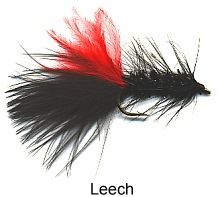 Damselfly
nymphs rise fairly vertical to within a couple of feet or
less from the surface and then swim quite rapidly towards
shore. Swimming action quite erratic.
Damselfly
nymphs rise fairly vertical to within a couple of feet or
less from the surface and then swim quite rapidly towards
shore. Swimming action quite erratic.
Dragonfly nymphs will travel by slowly crawling along the
bottom, they will swim fairly rapidly for short periods.
Shrimp and leeches swim at moderate
speeds with short and erratic burst of speed and pauses.
Your fishing productivity will be most
based on the combinations of fly pattern, size and
colour, the proper depth and fly line choice, appropriate
retrieve and selection of a productive area.
Most of all remember, that productivity
and enjoyment do not always have to coincide!
Have lots of fun and good luck!
Be sure to read all of the
other articles from Fred's Custom Tackle
& Fishing Adventures, the Fraser Valley's fishing authority.